MechanoChat#
MechanoChat
Inference and visualization of mechanical cell–cell communication from spatial transcriptomics data
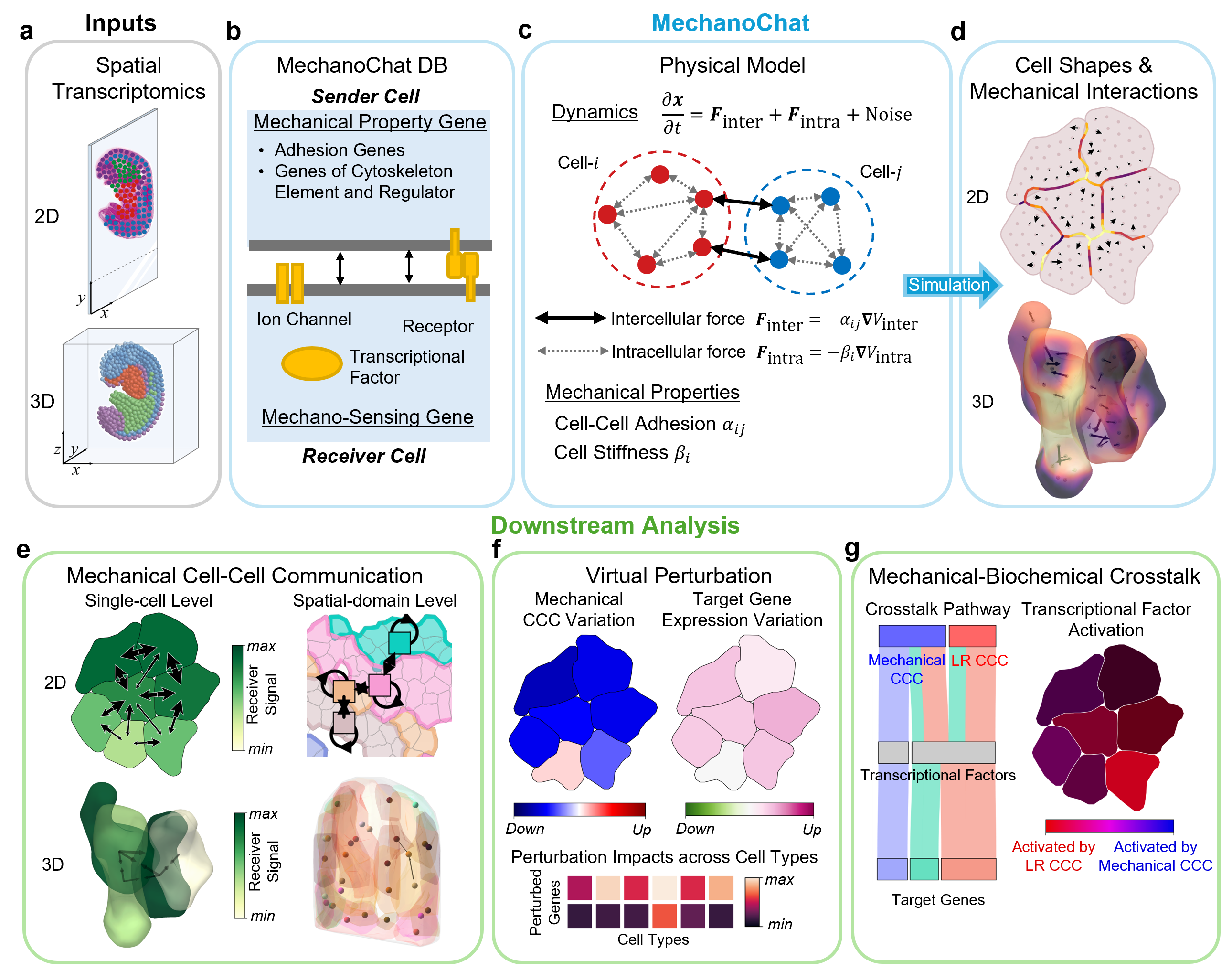
MechanoChat is built on the subcellular element method: each cell is represented by a collection of subcellular elements interacting through Lennard-Jones potentials, with per-cell adhesion and stiffness derived from gene expression. Relaxing this system reconstructs cell shapes and cell–cell contacts from spot/cell coordinates, and generates the forces acting between neighboring cells. These mechanical quantities are then coupled with the expression of mechanosensitive genes (ion channels, transcription factors, ligand–receptor pairs) to compute signaling between every pair of contacting cells.
Everything is written into the AnnData object (.obsp / .obsm / .uns),
so MechanoChat drops into a standard Scanpy workflow.
Requirements, CUDA setup, and the one environment variable you must set before running a simulation.
An end-to-end walkthrough on a seqFISH mouse embryo dataset, from raw coordinates to mechanical communication maps.
Every public function and class, grouped by module: SEM2/SEM3, pp, tl, pl.
Issues, releases, and the development version on GitHub.
What MechanoChat does#
- Simulate
GPU-accelerated (
numba.cuda) 2D and 3D SEM dynamics —SEM2,SEM3.- MechanoChatDB
Prior knowledge of mechanotransduction-related genes —
mechanochat.preprocessing(mc.pp).- Infer
Cell–cell contacts, forces, mechanical cell–cell communication, and crosstalk —
mechanochat.tools(mc.tl).- Visualize
Reconstructed cell shapes (alpha-shapes) and spatial distributions of mechanical communication —
mechanochat.plotting(mc.pl).
Citation#
If MechanoChat is useful for your research, please cite the repository until the accompanying paper is available.